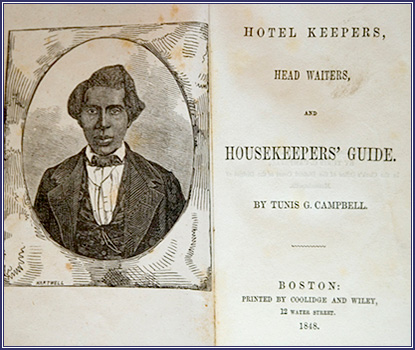
Tunis Campbell—the wild man politician of the Reconstruction

Tunis Campbell wrote a book before the war.

Accomplished African Americans like Virgil and Amanda who possessed specialized skills at the end of the Civil War must have felt incredibly overwhelmed at the work that lay before them in helping the enslaved to a better life.  Still, they plunged wholeheartedly into doing that work. Tunis Campbell, one of the most prominent politicians in Georgia at dawn of Reconstruction, was one of them.  He did his work with a flair and a somewhat reckless regard for the law, choosing to focus instead on what was morally right to him. He was an early example of civil disobedience from an African American.

Born in New Jersey, he was trained as a missionary for Africa.  In the wake of the Civil War, he was appointed as a agent for the Freedman’s Bureau in Georgia.  He was fired a year later, which tells me something about Campbell—he came to make radical change and folks didn’t like that.

He moved to a different part of Georgia,  and found a mostly black constituency in Darien in McIntosh County. and got himself elected justice of the peace (a much more powerful position then) and started to make some changes.  Edmund Drago explains it in Black Politicians and Reconstruction in Georgia, Campbell “exercised his powers arbitrarily and totally to the benefit of blacks.” Black crew members jumped ship from a British ship near Darien.  Campbell had the captain arrested and ordered him to pay court costs and the sailors’ wages. The problem was–Campbell had no jurisdiction.  He didn’t care.  He was the law in that town.

He got himself elected to the state legislature, but that didn’t stop the larger powers that be from trying to get rid of him.  They tried to bribe him, but he wouldn’t be bribed. They sought to have him arrested over the another unjust arrest of a white man.  That arrest stuck. In 1876, he was jailed for malfeasance in office.  He served about a year in a labor camp before he left Georgia for good.  He died in 1891 in Boston, Massachusetts.

It may be hard to see Campbell as a Union army chaplain and minister, but that was how he served.  Becoming a minister was one of the only ways a free African American man  could work with dignity and purpose. Ultimately, Campbell had had enough and left Georgia, but he provided an example to others of the formerly enslaved that they should not give up the fight for their rights and for equal opportunities.  Virgil represents the line between Tunis Campbell’s “radical” style and Henry McNeal Turner’s more sedate and patient approaches. Radical Reconstruction in Georgia needed all kinds of people to begin to pry open the closed doors of opportunity to everyone.


Virgil’s big brother in spirit–Henry McNeal Turner

Henry McNeal Turner had the right spirit for getting things done, but his too-trusting nature probably came about because he had never been enslaved.

In The Mayor’s Mission, Virgil Smithson becomes involved in a central event of the early Reconstruction era. In September 1868, the white Democratic members of the Georgia House of Representatives ousted the Republican African American members on the basis that they were not allowed to hold office. On that September third day, the African American members mainly made up of prominent ministers and town officials like Virgil, appointed Bishop Henry McNeal Turner to speak on their behalf. And he does. Turner gives one of the most important speeches ever given by an African American in United States History.

Born free in South Carolina in 1834, Turner served as a chaplain to the Colored Troops during the Civil War. After the Civil War, Turner was in Georgia to help organize churches to become part of the A.M.E. denomination. A freeman all of his life, Turner certified and organized ministers and churches regardless of their literacy. According to Stephen Ward Angell in Bishop Henry McNeal Turner and African-American Religion in the South, Turner was looking to capitalize on the recent gains of Reconstruction and to organize leaders. Then he sought to organize the schools to help with the problem of literacy amongst the recently installed leaders.

His efforts at organization singled him out to be elected to participate in the Reconstruction Constitutional Convention of 1867-68 (which Virgil attends). Politically, he was very conservative in manner and even, to the shock of some, supported policies that lenient to the former Confederates in allowing them suffrage and favoring a full pardon for Jefferson Davis. He even voted against inserting a proviso stating that the recently enslaved were permitted to hold office. He didn’t think it was necessary. In his Christian perspective, Turner sought to be forgiving and to make peace.

Unfortunately, this forgiving attitude about allowing African Americans to hold office came back to revisit Turner when, after the Constitutional Convention was over and he was elected to the Georgia House, Georgia Democrats united to get rid of the African American population of three Senators and twenty-six House members because they said the rights to citizenship did not include the right to hold office. After all, it wasn’t explicitly stated in the constitution so….

In his speech Turner said some remarkable things like: “No man has been more deceived by that race that I have for the last three weeks.” And “Am I a man? …If I am such, I claim the rights as a man. Am I not a man, because I happen to be of darker hue than honorable gentleman around me?” He spoke about his leadership qualities in serving as a chaplain but the twenty-nine politicians were thrown out of the House anyway.

Turner’s example is one that inspired me to reflect on how his efforts to build schools, organize churches and to seek political office began a new way of thinking about how African Americans participated in society. He certainly was a role model for Virgil Smithson, but my hero is not as patient as Henry McNeal Turner.